Case Study
Crescent Star Insurance Limited (CSIL)Insurance & Financial Services2013–2026
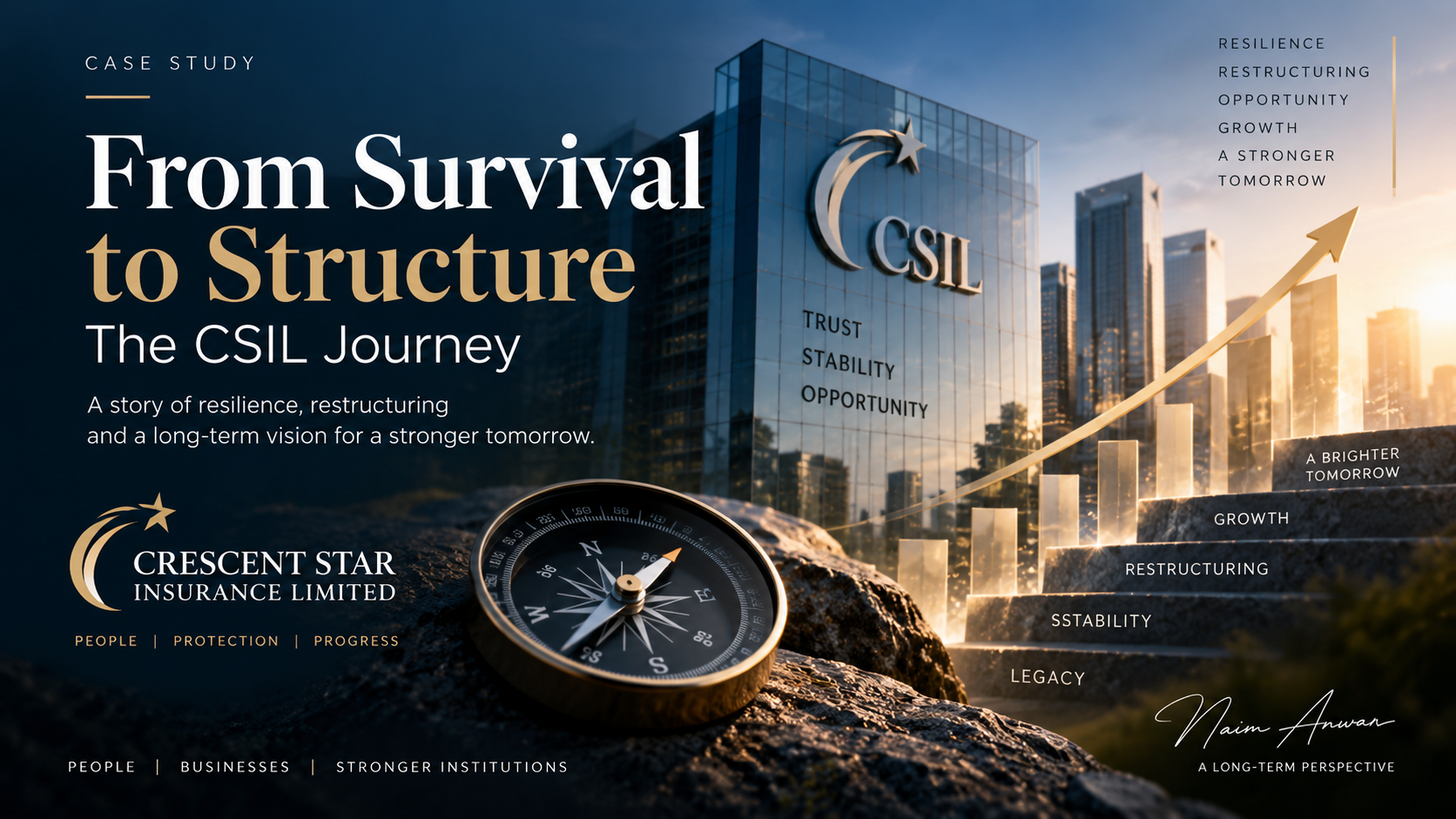
From Survival to Structure: The CSIL Journey
A CEO’s perspective on thirteen years of stabilising Crescent Star Insurance, navigating difficult decisions, pursuing restructuring opportunities, and building the foundation for a broader business group.
Naim Anwar
01
Introduction
In 2013, I took charge of Crescent Star Insurance Limited at a time when the company carried a complex legacy of old liabilities, receivables, regulatory matters, accounting issues and investments whose book values did not always reflect their underlying worth.
The task was not simply to grow the company. The first priority was to stabilise it, understand its challenges and create a foundation from which it could move forward.
Over the following thirteen years, the journey involved difficult decisions, diversification, regulatory challenges, litigation, restructuring opportunities and a gradual shift in thinking—from protecting what existed to building something that could create sustainable value.
02
The Situation
Crescent Star Insurance had history, a listing and an insurance licence, but it also carried the weight of legacy issues.
When I took charge in 2013, there were old liabilities, receivables, regulatory matters, staff and relationship issues, accounting challenges and investments where book value and actual worth could differ significantly.
The immediate challenge was to stabilise the core insurance business and deal with these matters step by step rather than trying to solve everything at once.
03
The Challenge
The central challenge was balancing survival with the need to create a path for future growth.
Some problems required patience. Others required difficult decisions. Regulatory matters and litigation created delays, costs and uncertainty, while diversification created its own lessons about what works and what does not.
The experience made one thing clear: restructuring is not a single event. It is a process that requires discipline, persistence and the ability to reassess decisions over time.
04
The Decisions
The first decision was to stabilise the core insurance business before attempting major expansion.
Over time, we explored diversification into areas including food and retail. Not every initiative performed as expected, which taught me that diversification must have a strategic connection rather than being pursued simply for the sake of expansion.
Another major decision was to continue pursuing the proposed merger involving PICIC Insurance despite the long regulatory and legal process.
The process began in 2017 and continued for almost nine years. On 16 April 2026, the Sindh High Court sanctioned the Modified Scheme of Arrangement connected with the transaction. Under the Scheme, approximately 7.9 billion PICIC shares are to be issued to shareholders of Crescent Star Foods, subject to implementation of the Scheme.
05
The Approach
My approach evolved as the circumstances changed.
First came stabilisation. Then came reassessment, restructuring and selective diversification.
Where regulatory decisions affected the business, we pursued the available legal and judicial processes where warranted while respecting the regulatory framework.
With distressed assets, the focus was on separating the condition of the company from the potential value of the underlying assets. Dost Steels was one example where patience and restructuring could be more meaningful than simply looking at the company's distressed position.
06
The Difficulties
The journey came with significant costs.
Litigation required financial resources and management attention. Regulatory delays created uncertainty. Some diversification initiatives did not deliver the expected results. Legacy matters continued to require attention while the business was being rebuilt.
These experiences reinforced the importance of liquidity planning, disciplined attention, professional management and understanding the difference between an attractive opportunity and a strategically appropriate one.
07
The Lessons
One of the most important lessons was that a company must survive before it can expand.
I also learned that diversification needs discipline, distressed assets need to be assessed for their underlying potential, and strategic investments should be evaluated separately from the core operating business.
Perhaps most importantly, the role of leadership changes with circumstances. My thinking gradually moved from that of an insurance executive focused primarily on the insurance business to that of a corporate restructurer thinking about institutions, capital, assets and long-term value.
08
The Outcome / Progress
By 2026, Crescent Star Insurance had moved beyond the immediate focus on survival and into a new phase of rebuilding and institutional development.
CSIL remains the principal operating insurance company. PICIC is intended to become a second listed financial platform once the merger is implemented and capitalised.
Crescent Star Technologies is intended to provide a technology and digital layer, while Crescent Star Ventures is intended to institutionalise experience in restructuring, capital raising, mergers and acquisitions and distressed opportunities.
The work is not finished. The next challenge is to translate the progress made into sustainable economic value, stronger operations and institutions that can continue beyond any one individual.
09
CEO Perspective
Looking back, I would not describe the journey as a straight line from difficulty to success. It was a process of making decisions, learning from them, reassessing and continuing.
The question changed over time. At first, it was whether the company could be stabilised. Then it became how it could be rebuilt. Later, the focus moved towards recovering value from investments and building institutions for the future.
That evolution has shaped the way I think about business today.
10
Key Takeaways
- 01
Stabilise before you expand.
- 02
Diversification should have strategic purpose and discipline.
- 03
Difficult assets can sometimes contain significant underlying potential.
- 04
Restructuring requires patience, persistence and disciplined decision-making.
- 05
Long-term value comes from building institutions, not simply pursuing short-term results.
- 06
Leadership evolves as the challenges and responsibilities change.
Related business