Business & Strategy
Why Distressed Assets Can Become Valuable Opportunities
Naim Anwar · September 7, 2026 · 5 min read
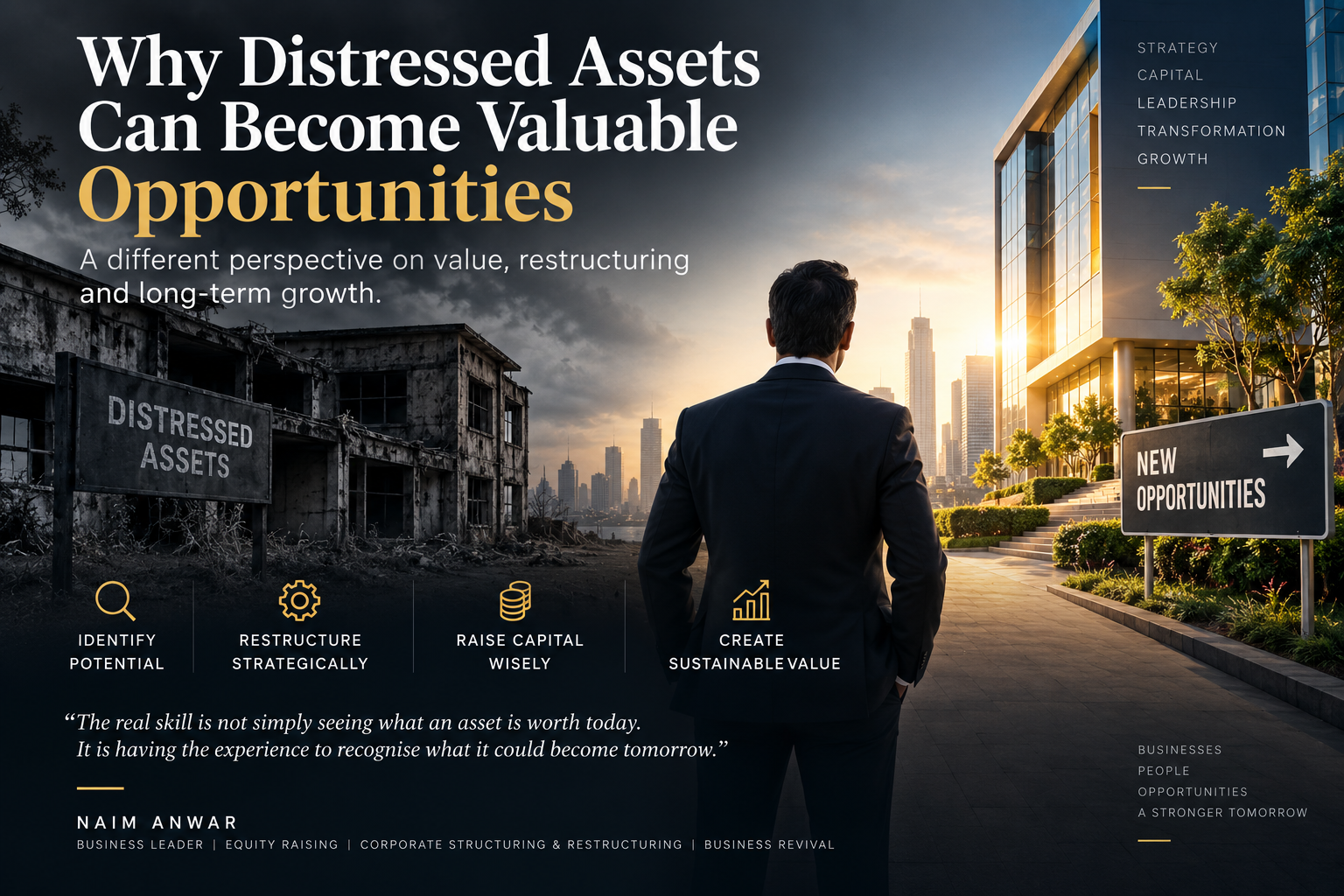
In business, an asset that appears weak, inactive or overlooked is not always without value.
Sometimes, the real opportunity is hidden beneath years of inactivity, operational problems, financial pressure, weak management or a business model that is no longer working.
I have learned over the years that the first question should not always be “What is wrong with this company?”
A better question can be:
“What could this company become if the right structure, capital, leadership and strategy were put in place?”
This way of thinking has influenced my approach to corporate restructuring, equity raising and business revival.
Looking Beyond the Current Condition
When evaluating an underperforming or distressed business, it is easy to focus only on its current condition.
Revenue may be weak. Operations may have stopped. Management structures may need improvement. Capital may be insufficient. The business may have lost its original direction.
But the current condition is only one part of the story.
A company may still have a corporate structure, licences, regulatory standing, market presence, assets, relationships, a listed platform or other characteristics that can potentially provide a foundation for rebuilding.
That is where strategic thinking becomes important.
The objective is not to rescue every distressed company. The objective is to identify which opportunities are worth rebuilding.
The Value Is Sometimes in the Platform
One of the most important lessons I have learned is that value does not always come from what a company is doing today.
Sometimes value lies in the platform itself.
An inactive company may provide an existing corporate structure. A listed company may provide a different strategic platform. An underutilised industrial asset may have potential under a new operating model.
But recognising that potential is only the beginning.
The real challenge is determining whether the opportunity can realistically be converted into sustainable value.
That requires careful analysis of the company's structure, liabilities, ownership, regulatory position, capital requirements, management capabilities and future business model.
Restructuring Is About More Than Cutting Costs
The word restructuring is often associated with reducing expenses, changing management or dealing with financial difficulties.
In my experience, restructuring can be much broader.
It can involve asking fundamental questions:
What should the company become?
Which business should it focus on?
What capital is required?
How should ownership and control be structured?
Can new investors participate?
Which assets have genuine potential?
What risks need to be addressed first?
What regulatory requirements must be considered?
Does the existing platform provide a better route than starting from zero?
Good restructuring is therefore not simply about fixing the past. It is about creating a workable structure for the future.
Capital Alone Does Not Solve the Problem
Another important lesson is that capital is necessary in many situations, but capital by itself does not guarantee success.
A company can receive significant investment and still fail if there is no clear strategy, appropriate management or disciplined execution.
Equity raising should therefore be connected to a business plan.
Before raising capital, I believe it is important to understand why the capital is needed and what it is expected to accomplish.
The purpose of the capital should be clear. Only then does equity raising become part of a broader restructuring strategy rather than simply a financial exercise.
The Importance of Timing
Distressed opportunities often require patience.
Regulatory processes can take time. Transactions can become complicated. Negotiations can change. Capital requirements can evolve. Unexpected obstacles can appear.
This is why I believe strategic patience is an important part of restructuring.
Being patient does not mean being passive. It means continuing to evaluate the opportunity while making informed decisions about when to act, when to restructure, when to raise capital and when to change direction.
Sometimes the biggest opportunities are not the easiest ones. They are the ones where experience allows you to see possibilities that others may overlook.
A Different Way of Looking at Risk
Every restructuring opportunity carries risk.
The answer is not to eliminate risk completely. That is rarely possible in business.
The objective is to understand the risk properly.
I look at questions such as:
What is the downside?
What can be controlled?
What cannot be controlled?
What resources are required?
What is the realistic path to recovery or growth?
And perhaps most importantly:
Is the potential opportunity large enough to justify the complexity involved?
From Distressed to Productive
The ultimate objective of restructuring should not be to create the appearance of success.
It should be to create a productive and sustainable business.
That can mean bringing an inactive platform back into operation, introducing new capital, acquiring an operating business, changing management, improving governance or creating a completely different strategic direction.
The journey can be complicated. But when the underlying platform has potential, disciplined restructuring can create a path forward.
What Experience Has Taught Me
Over the years, my professional journey has moved beyond traditional insurance into areas involving equity raising, corporate structuring, restructuring and business revival.
That evolution has changed the way I look at companies.
I no longer look only at what a business is today. I also ask what it could become.
That difference in perspective can be extremely important.
A company that appears inactive may have a future. A company facing difficulties may still have strategic value. An underutilised asset may become productive under the right structure. And a business that has lost its direction may sometimes be capable of being rebuilt.
But none of this happens automatically. It requires capital, structure, leadership, patience, governance and execution.
The Real Opportunity
The most interesting opportunities are not always the companies that are already performing exceptionally well.
Sometimes they are the businesses where the potential has not yet been fully realised.
Finding those opportunities requires experience.
Understanding them requires discipline.
Structuring them requires expertise.
And transforming them requires execution.
That is what makes corporate restructuring challenging — and, when successful, highly rewarding.
“The real skill is not simply seeing what an asset is worth today. It is having the experience to recognise what it could become tomorrow.”
Comments(0)
Loading comments…